Showing posts with label fiscal responsibility. Show all posts

Friday, September 03, 2021

A fiscal adult on the 'other' side of the aisle

 
One wouldn't expect to find a lot of bipartisanship concerning the federal $3.5 trillion spending bill -- and there isn't much to be found -- but courage and reason came shining through this piece by Senator Joe Manchin (D) of West Virginia. 

(Source: Wall Street Journal). 

Why I Won’t Support Spending Another $3.5 Trillion

The nation faces an unprecedented array of challenges and will inevitably encounter additional crises in the future. Yet some in Congress have a strange belief there is an infinite supply of money to deal with any current or future crisis, and that spending trillions upon trillions will have no negative consequence for the future. I disagree.

An overheating economy has imposed a costly “inflation tax” on every middle- and working-class American. At $28.7 trillion and growing, the nation’s debt has reached record levels. Over the past 18 months, we’ve spent more than $5 trillion responding to the coronavirus pandemic. Now Democratic congressional leaders propose to pass the largest single spending bill in history with no regard to rising inflation, crippling debt or the inevitability of future crises. Ignoring the fiscal consequences of our policy choices will create a disastrous future for the next generation of Americans.

Those who believe such concerns are overstated should ask themselves: What do we do if the pandemic gets worse under the next viral mutation? What do we do if there is a financial crisis like the one that led to the Great Recession? What if we face a terrorist attack or major international conflict? How will America respond to such crises if we needlessly spend trillions of dollars today?


Instead of rushing to spend trillions on new government programs and additional stimulus funding, Congress should hit a strategic pause on the budget-reconciliation legislation. A pause is warranted because it will provide more clarity on the trajectory of the pandemic, and it will allow us to determine whether inflation is transitory or not. While some have suggested this reconciliation legislation must be passed now, I believe that making budgetary decisions under artificial political deadlines never leads to good policy or sound decisions. I have always said if I can’t explain it, I can’t vote for it, and I can’t explain why my Democratic colleagues are rushing to spend $3.5 trillion.

Another reason to pause: We must allow for a complete reporting and analysis of the implications a multitrillion-dollar bill will have for this generation and the next. Such a strategic pause will allow every member of Congress to use the transparent committee process to debate: What should we fund, and what can we simply not afford?

I, for one, won’t support a $3.5 trillion bill, or anywhere near that level of additional spending, without greater clarity about why Congress chooses to ignore the serious effects inflation and debt have on existing government programs. This is even more important now as the Social Security and Medicare Trustees have sounded the alarm that these life-saving programs will be insolvent and benefits could start to be reduced as soon as 2026 for Medicare and 2033, a year earlier than previously projected, for Social Security.

Establishing an artificial $3.5 trillion spending number and then reverse-engineering the partisan social priorities that should be funded isn’t how you make good policy. Undoubtedly some will argue that bold social-policy action must be taken now. While I share the belief that we should help those who need it the most, we must also be honest about the present economic reality.

Inflation continues to rise and is bleeding the value of Americans’ wages and income. More than 10.1 million jobs remain open. Our economy, as the Biden administration has correctly pointed out, has reached record levels of quarterly growth. This positive economic reality makes clear that the purpose of the proposed $3.5 trillion in new spending isn’t to solve urgent problems, but to re-envision America’s social policies. While my fellow Democrats will disagree, I believe that spending trillions more dollars not only ignores present economic reality, but makes it certain that America will be fiscally weakened when it faces a future recession or national emergency.

In 2017, my Republican friends used the privileged legislative procedure of budget reconciliation to rush through a partisan tax bill that added more than $1 trillion to the national debt and put investors ahead of workers. Then, Democrats rightfully criticized this budgetary tactic. Now, my Democratic friends want to use this same budgetary tactic to push through sweeping legislation to make “historic investments.” Respectfully, it was wrong when the Republicans did it, and it is wrong now. If we want to invest in America, a goal I support, then let’s take the time to get it right and determine what is absolutely necessary.

Many in Washington have convinced themselves we can add trillions of dollars more to our nearly $29 trillion national debt with no repercussions. Regardless of political party, elected leaders are sent to Washington to make tough decisions and not simply go along to get along.

For those who will dismiss my unwillingness to support a $3.5 trillion bill as political posturing, I hope they heed the powerful words of Adm. Mike Mullen, a former chairman of the Joint Chiefs of Staff, who called debt the biggest threat to national security. His comments echoed the fear and concern I’ve heard from many economic experts I’ve personally met with.


At a time of intense political and policy divisions, it would serve us well to remember that members of Congress swear allegiance to this nation and fidelity to its Constitution, not to a political party. By placing a strategic pause on this budgetary proposal, by significantly reducing the size of any possible reconciliation bill to only what America can afford and needs to spend, we can and will build a better and stronger nation for all our families.

Wednesday, May 20, 2020

The downside of low interest rates (updated 1/2/2026)

Columnist Jeff Sommer published a piece called, "Dealing With the Dark Side of Low Interest Rates" in the May 17 edition of the New York Times. Mr. Sommer’s take is refreshing.  Monetary Doves and Pols on both sides of the aisle typically ignore the ill effects of low interest rates on conservative investors and senior citizens who receive abysmally low returns from their fixed income investments and don't have the time horizon for riskier investments.  

Mr. Sommer points out that in an ultra low rate world, retirees and those approaching retirement, are left with three poor choices... 

“Live on less, dip deeply into savings or take on more risk…”. 

A steady trough of cheap money and easy credit induces bad decisions that impact all of us.  As mentioned in this space over five years ago, a perennial ultra-low rate environment coupled with lax credit standards, was one of the factors that enabled the masses to over leverage and buy homes they couldn't afford before the housing bubble burst.  
Business vector created by dooder - www.freepik.com

We hear much about the economic benefits of low interest rates including increased capital investment and consumer spending; but there's also a down side.  

Asset bubbles and inflationary pressures strike us all when the cost of credit stays too low, too long.  Yet, it's still easy to find pundits and politicians who always advocate for lower interest rates.  Cheap money.  Who's not for that?

As for the once unthinkable prospect of the FOMC taking short terms rates below zero (a scenario also cited in Sommer's column); it was comforting last week to hear Fed Chairman Powell publicly tamp down the likelihood.  

---------------------------------------------------------------------------------------------

1/2/2026 -- AI sourced supporting research for this post follows:

1. Chicago Fed: Underpriced Risk and Liquidity

The Federal Reserve Bank of Chicago has detailed how "easy money" environments fundamentally alter lender behavior.

  • Underpricing Risk: Research shows that excess liquidity encourages lenders to be overaggressive, often underpricing the risk of loans in hopes that growth will offset future losses.

  • Historical Correlation: Analysis of the last 200 years of stock market bubbles indicates that, excluding war years, every major bubble occurred during periods of low inflation and low interest rates.

2. IMF (2025): Stretched Valuations and Stability

The most recent Global Financial Stability Report (October 2025) warns that the legacy of low-rate environments continues to pose risks.

  • Valuation Disconnect: The report finds that financial stability risks remain elevated because asset prices are stretched well above their fundamental values.

  • Nonbank Vulnerabilities: It highlights that nonbank financial institutions (NBFIs), which grew significantly during the low-rate era, now act as "liquidity providers" in ways that could amplify market shocks if valuations suddenly correct.

3. Richmond Fed: The Housing Bubble Precedent

The Richmond Fed has published extensively on how low rates create "the perfect environment" for speculative bubbles.

  • Speculative Shifts: Their research suggests that when returns on safe assets drop, investors speculate on riskier assets like housing to find yield, a primary driver of the early 2000s housing boom.

  • Financial Frictions: Another brief explains that bubbles increase the net worth of borrowers artificially, which temporarily eases credit but leads to severe "bubbly" recessions when the prices collapse.

4. European Research: Impact on Savers and Pensions

Studies for the European Systemic Risk Board (ESRB) and other EU bodies focus on the demographic toll of "low for long" rates.

  • Solvency Pressures: Protracted low rates put immense pressure on the solvency of pension funds and life insurers that provide long-term return guarantees.

  • Retirement Adequacy: The OECD notes that these environments force institutions to scale back benefit promises, directly impacting retirement income adequacy for conservative savers.


Research Summary for Your Blog Post

Research SourceKey Supporting DocumentCore Conclusion
Chicago FedAsset Price Bubbles ReportLow rates lead to excess liquidity and underpriced risk, fueling bubbles.
IMF (2025)Global Financial Stability ReportStretched asset valuations and nonbank financial risks threaten stability.
Richmond FedAsset Bubbles & ImbalancesLow rates were a primary factor in the housing bubble of the early 2000s.
ESRB / OECDMacroprudential Policy ReportSavers and pension beneficiaries bear the brunt of low-for-long environments.


Sunday, March 05, 2017

Economics 101 for the rest of us

Warren Buffet and Carl Icahn are famous investors but fewer people may know Ray Dalio.  Mr. Dalio founded an investment firm 40 years ago called Bridgewater Associates.  With $160 billion under management, Bridgewater runs one of the largest hedge funds in the world.
Bridgewater founder Ray Dalio, Bridgewater website

I recently discovered (among 3 million other people) a thirty minute YouTube video that Mr. Dalio produced to explain fundamentals of what he calls the economic machine

This video, which he narrates has been translated into several languages and viewed over 3,200,000 times.  The content begins slowly with basic concepts but progresses to explain the primary levers that policy-makers use to manage and stimulate the economy.  You can find it here.  

There are numerous lessons cleverly and clearly explained here.  Example: I hadn't appreciated why economists seem obsessed with Wage Growth until I watched this simple animated video.  The importance of wage growth has less to do with the oft-used and politically-charged phrase, "income inequality" and more to do with our collective ability to consume and deflate credit bubbles.

Also explained, is the concept of Credit, which Mr. Dalio asserts, "...is the most important part of the economy and probably the least understood". Other explanatory notes...
  • "A beautiful deleveraging" of our massive debt and deficits is the catalyst for a soft landing we all pray for in order to avert "social disorder" and societal collapse.  
  • Spending cuts are generally what people think of when they hear about "austerity" measures exercised by government, individuals and businesses to lower spending on goods and services.  
  • Wealth redistribution occurs primarily through higher taxation on upper income Americans.  
  • Money-printing refers to Federal Reserve purchases of government bonds and other financial assets ($2T since the Great Recession alone).

So what's the correct mix and emphasis of lever-pulling required for a soft landing?  Perhaps Mr. Dalio will address that question -- and what exactly is meant by a soft landing -- on this same platform at http://www.economicprinciples.org.

Saturday, August 27, 2016

The Fed's listening session

The Fed always inspires debates among stakeholders like institutional investors, economists, politicians, financial journalists and industry leaders.

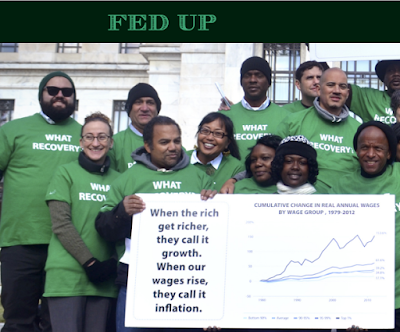
Now the Fed has received an activist group at its annual Jackson Hole symposium to hear their views on monetary policy.  This week, a movement called “Fed Up” sponsored by The Center for Popular Democracy met with Federal Reserve officials including Bill Dudley, president of the Federal Reserve Bank of New York

The Fed Up team merits an A grade for inventiveness.  Such groups often petition the legislative and executive branches of government that control spending and tax policy, but now one has successfully lobbied the The Federal Reserve within spitting distance.  To be fair, the group had some trained economists in their midst and they did nothing disruptive; but do political organizations belong at this annual forum?

Yes, economics and politics are inextricably linked, but Fed actions are logically debated on the long view of what’s good for the economy as a whole.  

The Fed's annual meeting shouldn't become a town hall with listening sessions like one conducted by your local Congressman.  

I haven't seen any reporting of the Fed Up attendees causing problems at Jackson Hole, but Fed officials' willingness to receive them in the first place is unsettling.  

After all, if Fed "independence" is advanced by the number of constituencies it receives in public, they must receive all comers.  Ultra low interest rates and massive bond buying by the Fed have juiced the stock market, but also crushed returns for elderly people living on payments from fixed income investments and cash.  Therefore, should the AARP or another group representing retirees have been granted equal time at Jackson Hole to advocate for monetary tightening?  

Saturday, November 17, 2012

The historical cycle that rings true today

A friend* trying to console me after Mr. Obama's re-election, shared a timeless quote:
"Again and again after freedom has brought opportunity and some degree of plenty, the competent become selfish, luxury-loving and complacent, the incompetent and the unfortunate grow envious and covetous, and all three groups turn aside from the hard road of freedom to worship the Golden Calf of economic security.  The historical cycle seems to be: from bondage to spiritual faith; from spiritual faith to courage; from courage to liberty; from liberty to abundance; from abundance to selfishness; from selfishness to apathy; from apathy to dependency; and from dependency back to bondage once more."
Icon by Arfianta at freepik

Those prophetic words came from the leader of a Pennsylvania company during a speech on March 18, 1943.  The speech was delivered by Mr. Henning Prentis and his words ring true today. 
 
*Thanks, Kevin.

Saturday, June 09, 2012

Maddente.com raison d'être

Raison d'être -- is French for "reason for existence" -- which is a heady concept.  I'll define this blog's raison d'être for my five six readers, with this post.  Many of my posts center on fiscal responsibility. 
Fotosearch Image

So when I see a column I agree with as I did today in WSJ by Steven Malanga ("State Politicians and the Public Pension Cookie Jar") -- I share it and talk about it.  I hope in a small way, I'll add attention to the generational burden-shifting and recklessness taking place (and it feels good to get gripes out of my system and into a post).

Mr. Malanga focuses on one part of a multi-faceted national spending problem -- defined benefit programs for public employees -- better known as public pensions.  I didn't understand how costly they are until some six years ago, when a retired pediatric dentist of all people, began to educate me.

I also have misgivings about pension plans in the private sector, but shareholders of those pension-granting organizations choose where to invest their money.  Put differently, if a majority of company shareholders wish to tolerate expensive employee retirement and health care plans -- that's their business.  Investors can and do vote with their feet.  But taxpayers can't sell their shares, or wage a proxy fight. So, public pension reform is my topic du jour (OK, that's it for the French phrases -- I promise). 

Fortunately, voters are beginning to wake up and support leaders like Governor Scott Walker and the fiscal reforms they sponsor to curb these budget busters in the public domain.

Someone asked me why I haven't been posting much lately.  The answer is I've been busy working and like most working Americans -- trying to add to my defined contribution plan.
-------------------------------------------------------------------------------------------------

Governor Scott Walker / Wikipedia Image
Finally, I'll share another column also found in today's WSJ  by Peggy Noonan about Governor Scott Walker's resounding win this week, called "What's Changed After Wisconsin". 

Mr. Walker, whom I hope you'll remember -- not recall -- is the first recipient of the Maddente MVP Award for public adherence to fiscal responsibility.

Saturday, March 17, 2012

A refreshing perspective from Phil Gramm. It's not just about the banks

OBloomberg TV last monthformer U.S. Senator Phil Gramm discussed the housing meltdown, as well as, his own work to deregulate the banks.  

Phil Gramm, Wikipedia
During the course of the interview, Mr. Gramm highlights "concerted government action and pressure on banks" to make sub prime loans and destructive decisions in Washington "to force feed housing" ownership.

The Bloomberg interviewer insinuates that there were as many predatory lenders as predatory borrowers.  So, exactly, what is a predatory lender?  I believe many borrowers were unaware of the potential risks of their variable rate mortgages.  That's fair.  

However, were millions of people buying more home than they could afford, or sucking more equity out of their homes than they could afford to lose; all largely duped?  I never believed so and still don't believe so.

Gramm asserted that for every subprime borrower who actually got swindled by lenders, there were "one hundred" that exploited the system, i.e., predatory borrowers.  There's the debate, Mate. 

That millions of borrowers bought properties they couldn't afford, recklessly used cash out financing, or shouldn't have been in variable rate notes in the first place, is clear.  We will debate for years which players and policies enabled the whole sorry misuse of credit.  Laying the entire mess at the hands of bankers is conveniently populist, but incorrect. 

If you don't have time for the whole interview, consider moving the needle to the six-minute mark.

Tuesday, September 27, 2011

'Tis but a scratch

When the bills come due, nations that have fallen prey to the entitlement vortex can foster street violence and class warfare when the coffers are empty.  Some leaders can also breed denial once they run out of money.   

That's the reaction of some Greek politicians who don't appreciate the futility of their fiscal situation.  A year and a half ago, German officials averred that part of a Greek bailout plan could involve the sale or lease of state-owned assets, as well as, other austerity measures. 

This proposal did not amount to a wholesale transfer of Greece's sovereignty as its opponents claimed.  Rather, it was part of a larger plan to lift a struggling debtor out of its self-induced mess through privatization of government assets including some Greek islands.  

In response one Greek government official said, if such asset transfers came to pass, it will result in a Greek boycott of German goods.  This threat seems to ring hollow.  They're broke, they can't borrow and they threaten not to buy products.  I'm reminded of the Black Knight from Monty Python and The Holy Grail.  After being drawn and quartered, the dismembered knight vowed to attack his foe (who didn't want to fight in the first place).  

                                                                 YouTube Video

Above is the clip.  Watch King Arthur's reply to the Black Knight, which could be Germany's reply to the aforementioned Greek official, "What are you going to do, bleed on me?"  

I'm sympathetic to the suffering in Greece, but it's hard to abide politicians who want to perpetuate the irresponsible government spending and market meddling that caused their mess.  

At the end of a 99 year lease, the British honored their treaty with China and transferred sovereignty of Hong Kong in 1997. Life went on.  Perhaps a multi-year lease of Mykonos would help matters. 
-----------------------------------------------------------------------
October 2, 2011 - NEWS UPDATE - Reuters just released this report on the Greek financial crisis...

"The Greek cabinet is expected to approve a contentious plan Sunday to lay off state workers, and sign off on a draft of next year's budget, in a race to slash spending, free up bailout loans and stave off bankruptcy.

Without the release of an 8 billion euro ($10.7 billion) tranche of an EU bailout, massively indebted Greece could run out of money to pay state wage bills within weeks.  European officials are scrambling to avert a Greek debt default, which could wreck the balance sheets of European banks, damage the prospects of the euro single currency and possibly plunge the world into a new global financial crisis."

Sunday, August 14, 2011

When compromise and experts are dangerous

With a title like, "Are Economists Really That Smart" I had to read Bill Flax's piece in this month's issue of Forbes magazine, especially after digesting his first sentence, "Remember when Joe Biden admonished us to keep spending or else we'd go bankrupt?"  Mr. Biden's statement reminded me of something Nancy Pelosi uttered before enactment of the unpopular Obamacare legislation affecting 1/6th of our national economy.  Of course, Joe Biden and Nancy Pelosi are not trained economists, nor am I, but these people are running the country.  This clip is only two seconds...

My timing to read the aforementioned Forbes piece was good since I'd just finished fighting my way through Nassim Taleb's best selling book, The Black Swan.  (I say "fighting" because several technical aspects are beyond me).

In their own ways, Messrs. Flax and Taleb fillet and roast the cadre of economists, public policy-makers and financial journalists who worship at the Keynesian alter.  Living within one's means and free market principles are concepts ignored, even ridiculed, by economic intelligentsia as they advocate for trillions in "stimulus".  

Their voices clamor for more government spending.  The reason QE2 failed, according to these experts, is that the sum wasn't large enough and all the fresh liquidity wasn't given enough time to work.  On the other hand, economists like Nassim Taleb see the economic calamities we now face through a different lens.  But back to the Forbes, piece.  

Mr. Flax says of economics and its modern day application to fiscal policy, 

"The principal failing of macroeconomics is the intrusion it invites and the certainty it instills in politicians...no planner, no matter how wise, could possibly appreciate all the subjective nuances lurking behind these numbers.  Such schemes are doomed to folly."

There also exists today, a notion that Pols sparring over fiscal policy must "compromise" as if the key to solving our economic morass falls in the middle of some ideological bell curve. 
Icon by Creatype at freepik

Compromise might produce added legislation, but it won't cure a deficit spending addiction.  Consider Nassim Taleb's eighth principle for a Black-Swan-Robust Society,

"Do not give an addict drugs if he has withdrawal pains.  Using leverage to cure the problems of too much leverage is not homeopathy, it's denial.  We need rehab."

1900 advertisement treatment for morphine addiction - Wikipedia


The same metaphor I used in January of 2009 (and used elsewhere by others) of a drug addict who needs to take the pain, was also used by Dr. Taleb.  

The point is one cannot compromise with a drug addict, they only come back for more, which is why we must lower federal spending.  Tax increases and money printing are analogous to a government's morphine fix -- it feels good for a while, but it only makes the problem worse before the inexorable crash.  We must go cold turkey and take the pain incrementally.  

Tuesday, December 28, 2010

Public Notice - the bankrupting of America

Public Notice is "an independent non-profit dedicated to providing facts and insight on the economy and how government policy affects Americans’ financial well-being."  

Here's a slide from them (with holiday flair) called "The 12 Days of Government Spending"


Thursday, November 04, 2010

A post-election reply to Mortimer and Stanley

Wikipedia
Here are excerpts from a reply to two friends - disguised with fake names - Mortimer and Stanley.   

These guys fall at opposite ends of the political spectrum, but their exchanges are always respectful.  The three of us have been "sparring" since our teens. 

Some text changed, but it is close to the original version when I responded to their post-election e-mail dual of 11/3/2010...

"Dear Mortimer and Stanley,

I love your passionate sentiments about today's political landscape and all that ails us.  I agree with both of you - to an extent. Ah, the advantage of going last...

I'll start with Stanley and his Mortimer rebuke - "Greed and avarice are as old as the Bible, Morty. And the Democrats are experts on that."  

Stanley, I assume you mean Dems are experts on greed, not the Bible.  Some Republicans also know greed, as do some Libertarians.  What's missing in your criticism, is the role of of the players who make policies, appropriations, budgets and tax incentives that perpetuate our fiscal hell. 

Take, the housing bubble, which was enabled by government policies (sorry Morty, mainly Dems and the Fed in my view) when millions of Americans "bought" houses that they could not afford.  That experience is the perfect example of why we are broke as a nation and as a people. We ate too much, drank too much, bought too much, saved too little and then the bill came due. 

Yes, we have a consumer-based economy Morty and it's a giant Petri dish of self indulgence.  An economy so dependent upon domestic consumption strikes me as doomed as ancient Rome.

Our sense of liberty gave way to gluttony and we confuse the two nouns. 

These election outcomes?  Yes the people have spoken Stanley, but will a new majority in power practice sound fiscal principles by telling voters what many of them don't want to hear?  Will tax cuts be matched by corresponding spending cuts?  We'll see what the new Congress tries in January, but I don't believe we can tax our way out of the hole, or depend upon government to be a good steward of the peoples'' wealth.  Nor can the Fed save us by printing cash.  What's the pain remedy?  First we must take some pain.  

Live within our means, keep the dollar strong and responsibly scale back entitlement programs.  Social Security, Medicare, a bevy of state and other federal programs, public sector defined benefit retirement plans, as well as Cadillac health plans are all part of the same problem.  Some austerity measures can kick in now, not in 2025.

As for Mortimer's remorse regarding Mr. Feingold's election  fate, I was pleased but not surprised.  My view on how Russ Feingold devolved as a public servant would take time, but here's a taste...

You called him a Maverick, Morty.  Sometimes yes, but not always when it mattered.  His lonevote against the Patriot Act was pointless grandstanding.  He acted as though he had a monopoly on wisdom and constitutional purity that somehow eluded 98% of the United States Senate (one senator didn't vote on the measure).

Libertarians later rebelled against this Maverick after he voted for his party's stimulus package and Obamacare.  All this and years of inactive legislative performance sunk his boat, Morty.  He fell in love with being a Senator and made an ill-timed dart to the entitlement-loving, Left.  It was too late for him to retreat to the Center. 

I'm done for now, but know this men -- I can still drive to the hoop better than either one of you ever could, although I concede you were both better students. 

Your devoted friend,

John

Thursday, October 14, 2010

A fiscal adult -- David M. Walker

Consider the national debt which as a percentage of gross domestic product is at its highest levels since World War Two.  Click here for a real-time depiction of our debt and consider the faith that the rest of the industrialized world has in the United States as a beacon of financial stability. 

What happens when that changes?  Why are some observers more worried about climate change than global economic calamity that is looming in our midst? 

We need more leaders like Mr. David M. Walker.  This post is dedicated to his mission.  Some might think I'm joking when I say that what we need in Congress and the White House right now are accountants.  I'm actually serious.  Mr. Walker, by the way, was an Arthur Andersen partner several years ago. 

We need people who can balance a budget and say "no" and be proud to say no because it is right and just.  The only anecdote for a nation addicted to debt are politicians with the fortitude to say, "You'll be getting less now and you'll wait longer to receive it.  Sorry."

Mr. Walker is willing to accept more tax increases to offset spending cuts than many of us would like to see -- as opposed to demanding proportionally-larger spending cuts.  Yet, I still admire his zeal to reclaim a fiscally-sane America.
David Walker: Wikipedia

I invite you to learn more about him by clicking on this Wiki...


Fifty Year Mortgages? An awful idea.

The WSJ editorial team nailed it today:  https://www.wsj.com/opinion/50-year-mortgage-donald-trump-bill-pulte-housing-prices-5ca2417b?st=N1W...