Saturday, August 27, 2016

The Fed's listening session

The Fed always inspires debates among stakeholders like institutional investors, economists, politicians, financial journalists and industry leaders.

Now the Fed has received an activist group at its annual Jackson Hole symposium to hear their views on monetary policy.  This week, a movement called “Fed Up” sponsored by The Center for Popular Democracy met with Federal Reserve officials including Bill Dudley, president of the Federal Reserve Bank of New York

The Fed Up team merits an A grade for inventiveness.  Such groups often petition the legislative and executive branches of government that control spending and tax policy, but now one has successfully lobbied the The Federal Reserve within spitting distance.  To be fair, the group had some trained economists in their midst and they did nothing disruptive; but do political organizations belong at this annual forum?
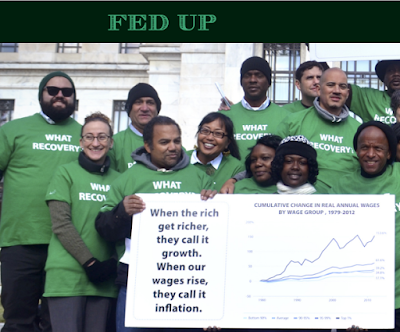
Yes, economics and politics are inextricably linked, but Fed actions are logically debated on the long view of what’s good for the economy as a whole.  

The Fed's annual meeting shouldn't become a town hall with listening sessions like one conducted by your local Congressman.  

I haven't seen any reporting of the Fed Up attendees causing problems at Jackson Hole, but Fed officials' willingness to receive them in the first place is unsettling.  

After all, if Fed "independence" is advanced by the number of constituencies it receives in public, they must receive all comers.  Ultra low interest rates and massive bond buying by the Fed have juiced the stock market, but also crushed returns for elderly people living on payments from fixed income investments and cash.  Therefore, should the AARP or another group representing retirees have been granted equal time at Jackson Hole to advocate for monetary tightening?  

Saturday, May 21, 2016

The shiny penny syndrome (updated, 12.28.2017)


This post is about business development (BD).

There's a BD ailment in the professional services markets (and other markets I suppose) which I call, "Shiny Penny Syndrome".  

Symptoms include short attention spans, misplaced time allocation and indifference to existing prospects.  The time professionals have for BD is finite and good BD takes time. What often subverts efficient use of their time, is Shiny Penny Syndrome.  It works like this...

We're all so eager to attain revenue goals, that all it takes is a simple distraction to catch our eye (i.e. a shiny penny).  The promise of a hot lead at a new prospect often retards efforts at existing prospects by shifting valuable attention and resources away from them.  Frequently, we drop everything to chase a sale at an unqualified prospect requiring a time consuming proposal with a quick turnaround.  

It's impossible to avoid that shiny coin 100% of the time, but when we pursue them habitually, we're trading higher probability conversions in our existing pipeline, for long shots.  

I'm not advocating slow starts to reasonably-qualified, time sensitive, opportunities. I'm suggesting there's an unacknowledged price to pay when professionals repeatedly turn their energies toward unqualified prospects seeking fast fee quotations, project budgets, proposals, conference calls, etc.  It all takes time.

Professionals can't totally inoculate themselves from Shiny Penny Syndrome -- it requires discipline to walk away from pursuits that appear quickly and often dramatically.  Emotions can run high on both sides of a decision to pursue or not pursue the new "opportunity".  Nobody wants to appear as though they lack aggressiveness.  So how can we reduce our exposure to unhealthy pursuits of shiny pennies?  

One method is to calculate your ROI for these pursuits (and share among market-facing peers).  Total the estimated fees coming from wins of these pursuits over a twelve month period or longer (a dollar value easy to compile because data points will be sparse).  Next, attribute a reasonable dollar value for the sum total of all the time and resources expended on shiny penny pursuits, over the same time period.  Next, divide the estimated fee value, by the total time and resource value.  That's your ROI for these moonshots.

Another method is adoption of an opportunity assessment standard.  Even a few qualification questions consistently considered, are better than nothing.  Use questions to assess unknown, proposal-anxious prospects and arrive at an informed team consensus on how (or whether) to proceed with a given pursuit.

I close with some sample questions below.*  
  • Will direct contact with stakeholders and decision-makers occur before proposal issuance?  
  • How many competing firms will the prospect allow into this RFP process?  
  • What market reputation do we possess for this specific type of work?  
  • Do any C-level executives or board members at the prospect, already know us?  
  • Does the RFP process more closely resemble a commodity auction run by procurement managers, or a thoughtful vetting of individual firms by key stakeholders? 
  • Why were we invited to participate?
  • Why is the prospect going out to bid?
  • Is there enough time to develop sufficient understanding of the prospect's business?
  • Can our experience and existing relationships produce unique value and insights, or merely rates and dates in a proposal?
  • To what extent can geographic proximity or reference-able clients, weigh in our favor?
*If you can't obtain answers to your questions, or several answers don't inspire confidence, consider a decision to politely request more evaluation time or decline the RFP invitation (and turn your attention to better qualified opportunities).

(image above by freepik)

Saturday, April 09, 2016

"We're all on a journey in this life"

Interesting people and teachable moments are often nearby.  At conference in Chicago some years ago, I made an unlikely acquaintance whose words resonate with me this morning. He is an industrial psychologist who practices in the financial services space.  Before his clients extend lucrative offers to hire C-level executives, candidates must pass his carefully curated assessment.

So I plied this man, Grant, with questions to learn what he looks for and who ultimately receives his endorsement.  Grant told me a little about his trade at a technical level, but when he got to the part about who fails his assessments, I was struck by the simplicity of his answer.  

It turned out that an outsized ego is the kiss of death for candidates seeking his approval.  He explained that an executive that pretends to have all the answers often has a high probability of sub-par performance at his clients' businesses.  To summarize his point, he said, 

"We're all on a journey in this life and those who don't understand that..." are going to fail.  

He suggested that humility and intellectual openness are key attributes of senior executives with sustainable records of success.  Maybe his principle doesn't apply to all interviewers, but his filter works for his clients.
----------------------------------------------------------------------------------------------------
Inspired by Dr. Grant, it is with humble hat in hand that I recite my incorrect 2015 Halloween projection.  I believed Sen. Rubio would become our GOP presidential nominee.  Did I know his campaign was over after he collapsed under pressure from Chris Christie?  No, but it was clearly downhill from there.  He'll try again and probably be stronger the next time he encounters smash mouth moments at a debate.  

Carly_Fiorina_by_Gage_Skidmore_3
At present, I'm sticking with my dark-horse Halloween projection for the VP running mate -- Carly Fiorina -- if either Ted Cruz or John Kasich should capture the nomination. Either ticket would make a formidable team and one infinitely preferable to the prospect of a Clinton or Sanders presidency. 


Sunday, February 14, 2016

Pol update & remembering Justice Scalia

On Halloween night I wrote,  "Donald Trump and Ben Carson will decompose in the coming months and try to trade whatever political capital they have in the form of an endorsement, for something they can use to remain relevant".  I also wrote Marco Rubio would become the GOP nominee.   (More fun paring back the candidates, October 31, 2015).  

I stand by these predictions although I now believe Trump may withhold his endorsement of another candidate.
---------------------------------------------------------------------------------------------

Millions of Americans are mourning the loss of Justice Antonin Scalia.  He was a colorful, principled and brilliant American jurist.

Justice Antonin Scalia
Wikipedia image
Much has been discussed about his near obsessive attention to originalism (which I learned today he sometimes called textualism).  It means a focus on the intent of the Founders and a dedication to their wording embedded in the U.S. Constitution.  Justice Scalia would often admonish anyone with a desire to understand the Framers intent to read the Federalist Papers.  In fact he was aghast that some law school students haven't read them.  

He was true to those principles as exemplified by this passage from a Wikipedia page...

"Scalia responded to his critics that his originalism `...has occasionally led him to decisions he deplores, like his upholding the constitutionality of flag burning', which according to Scalia is an expression protected by the First Amendment." 

Monday, November 16, 2015

Vive la France!


France vector mapI sympathize with the great nation and people of America's oldest ally FRANCE.  May God soothe their anguish at this difficult time following the deaths of 130 French citizens at the hands of jihadist murderers.  Our President is mistaken about the national security challenges we face.  Unfortunately, he proclaims that evil abroad is "contained".  All the while, the national debt has grown more under his tenure than it has under all previous US presidents combined.  Perhaps that's why a former Chairman of the Joint Chiefs of Staff famously quipped that the biggest "...threat to our national security is our debt."

Thursday, August 13, 2015

A clear and present danger to civil liberties

Destruction of evidence, failure to comply with Congressional subpoenas and giving false testimony before Congress, are impeachable offenses.  One might think of Watergate, but these same offenses also apply to the IRS scandal I wrote about over two years ago ("IRS Plot Could Be Worse Than Watergate" June 9, 2013).  Little fallout has occurred since.

An article for interested readers to examine, was published in the Wall Street Journal (WSJ) last month by Congressmen Ron DeSantis and Jim Jordan.  Anyone who still denies existence of a partisan scandal might want to read this WSJ article:

"The Stonewall at the Top of the IRS" -- July 28, 2015
by Congressman Ron DeSantis and Congressman Jim Jordan

(Also worth reading in WSJ: "How Congress Botched the IRS Probe" -- May 15, 2015 by Foley & Lardner attorney, Ms. Cleta Mitchell.)

Last week, during the Republican Presidential debates, Sen. Rand Paul complained about meta data collected to catch terrorists, but he said nary a word about the IRS issue. 
IRS Commissioner John Koskinen
Official photo
The IRS scandal is more tangible than any federal surveillance problems we've seen, yet Sen. Paul prefers to focus on the NSA without evidence of citizen abuse.  

To be clear, I cherish privacy rights and respect the instincts behind Senator Paul's effort, but I also wonder why he is not more troubled by what's occurred recently at the IRS. 

Sunday, April 26, 2015

Spring has sprung!

While it's still too cool in southern Wisconsin to get excited about the weather, the morning sunlight streaming across my lawn is enough.  A week of travel on a sour stomach and poor weather in north Texas, makes me appreciate the moment all the more.  

Image by freepik

On a heavier note; I recently discovered a quote by John Stossel.  I don't know much about Stossel, other than he's a Libertarian.  I've only seen a few of his topical reports on television but his pithy take on the nature of taxation is amusing.  Mr. Stossel says....

"Politicians, bureaucrats and the people they 'rescue' get money through force — taxation.  Don't think taxation is force? Try not paying, and see what happens."


Fifty Year Mortgages? An awful idea.

The WSJ editorial team nailed it today:  https://www.wsj.com/opinion/50-year-mortgage-donald-trump-bill-pulte-housing-prices-5ca2417b?st=N1W...