My online comment...
"Have we learned nothing from 2008-2009? This is a bad idea and a dangerous one. The easy answer of pile on more debt to improve affordability, hastens another meltdown. We don't have a demand problem, it's a supply problem."
My online comment...
"Have we learned nothing from 2008-2009? This is a bad idea and a dangerous one. The easy answer of pile on more debt to improve affordability, hastens another meltdown. We don't have a demand problem, it's a supply problem."


![]() |
| Freepik image |
Everything is cyclical
Even the seasons are.
Don't let Fall depress you
As midwest nature is put on hold.
It does not die,
It changes.
The deciduous shed their leaves
Leaving the sculptured trunk
To rest
In quiet serenity, only to greet us
Again in the spring.
The coniferous endure
Proudly, stoically
Through the cold white days.
It is cyclical, like life
The perfect dichotomy
From fetal origin
We go through life's changes
And then
Only to return to our beginnings.
An awesome experience
Enjoy it!!
Everything is cyclical...........
Pointed, brilliant drifts of snow
pierce the evening of winter.
Curving upward they arch
to a luminous, cyclopean moon.
A guest, humble, I stand here
beneath flickers in northern skies.
Icy grains atop snow drifts,
move obediently for winter gusts.
One drift releases grains to its neighbor.
Tumbling crystals, indifferent, brush sodden drifts.
A rabbit stops to listen.
![]() |
| Paul Krapf image adapted |
I apologize for the poor granularity of the picture below which I snipped from a post on LinkedIn (my fault not theirs). For me, Stephen Miller's quote cuts to the core of the debate on due process and lllegal migration.
"The right of "due process" is to protect citizens from their government, not to protect foreign trespassers from removal. Due process guarantees the rights of a criminal defendant facing prosecution, not an illiegal alien facing deportation."
![]() |
| The Atlas Society post on LinkedIn |
In Oliver Stone's 1995 biopic film about President Richard Nixon, there's a memorable passage attributed to H. R. Haldeman. Haldeman is lamenting the fact that Nixon's key advisors including himself, failed to give Nixon pivotal advice about the Watergate scandal before it consumed his presidency. The Haldeman character portrayed by actor James Woods says,
"Eight words back in '72. 'I covered up. I was wrong. I'm sorry'. The American public would have forgiven him."
Flash forward to our present day controversy about Trump senior team members' use of the encrypted messaging app Signal -- an issue the Left has cheerily dubbed "Signalgate"-- and some historical parallels emerge.
Let's dismiss one trope immediately, this embarrassing episode will not engulf the Trump administration, although NSA chief Mike Waltz may take a fall. To his credit, Mr. Waltz recently took the Haldemanesque approach with a straightforward admission on Laura Ingraham's show,
"I take full responsibility. I built the group," "It's embarrassing. We're going to get to the bottom of it." Smart. If only the whole administration had followed suit.
I don't know what sort of reputation The Atlantic Editor in Chief Jeffrey Goldberg enjoys in media circles, but the Trump team has little to gain by trashing him now. Although The Atlantic juts to the Left, they didn't create this mess. As we now know, Goldberg was mystifyingly added to the chat group by Mike Waltz, or Mr. Waltz's proxy. Blaming the technology, (or Goldberg) for Goldberg's errant invitation to a sensitive high level government session, doesn't hold water. This inspires a personal recollection...
Years ago, a colleague and I attended a competitors' financial conference in Chicago. From a business development perspective, it was a target-rich affair with several prospective clients in tow. After soliciting one of the organizer's clients, my colleague and I were thoroughly berated at breaktime by a hosting executive because he learned that I had the temerity to approach his client at "their" event. The executive wanted us to leave immediately. (We did not). I protested by pointing out that his own marketing team had invited us. We'd been mistakenly invited; but we hadn't crashed the party. Moreover, being direct competitors; the enraged sponsor shouldn't have reasonably expected us to confine conversations with attendees to benign issues like the weather.
![]() |
| image by freepik |
Let's instead get on to the business of apprehending and deporting illegal migrants and stopping waste, fraud and abuse of taxpayer funds. Those are winning endeavors that enjoy broad support and require no public excuses.
This morning, I attended a seminar about the "Psychology of Golf". The topic intrigued me because all of my personal golf instruction -- and that which I've observed for other golfers -- focuses upon the physical aspects of the game. The swing, the grip, addressing the ball, the stance, club selection, etc.
![]() |
| Image by drobotdean on Freepik |
![]() |
To sum it up using 2024 public statements, PolitiFact Wisconsin published articles that identify Conservatives for falsehoods, 25 out of 33 times (76%). Now, neither party has a monopoly on the truth; but editors using content from PolitiFact Wisconsin disproportionately target Conservatives. At least for 2024, I rate that assertion True.
|
|
|
|||
|
|
||||
|
| ||||
Last year, consumers and small businesses used the free peer to peer online payment platform called Zelle, to complete $806B worth of transactions. In 2023, three billion Zelle payments equated to $100 million of transaction activity....per hour.
The Zelle platform owners are seven of our nation's largest banks. Those banks and over 2000 smaller banks and credit unions -- make Zelle available to customers for simple, instant, fund transfers. Unfortunately, there are countless bad actors preying on unsuspecting payers.
![]() |
| freepik image |
Consumer watchdog groups, the Consumer Financial Protection Bureau (CFPB) and politicians like Elizabeth Warren, Sherrod Brown and Maxine Waters have targeted Zelle's operator, Early Warning Services, LLC (EWS) and large bank owners of the platform, for consumer losses due to fraud.
On December 20th, the CFPB announced it was suing EWS and the three largest banks that own Zelle for insufficient fraud detection, prevention measures and victim support. Their press release alleges that the defendant banks have been "...allowing repeat offenders to hop between banks."
Banks and credit unions, law enforcement, the press, our judicial system, industry trade groups, technology backbone companies and state and federal agencies dedicated to apprehending and prosecuting financial criminals are all powerful stakeholders with a role to play.
No single party is responsible for "allowing" criminal activity to go unchecked.
Moreover, millions of individuals attracted to the convenience of online payment technology could dent victimization levels by using extra caution before sending money to an unknown counterparty. Unfortunately, much of this thinking gets lost within the 'Big Bad Banks' hype.
Scale of the Problem? Which problem?
The CFPB claims that the cumulative amount of Zelle-related fraud losses by consumers since 2017 is $870 million. EWS disputes that figure and notes that some claims turn out to be legitimate payments and other anomalous cases (like claims made by actual fraudsters trying to exploit the system) inflate the CFPB statistic.
Accurate or not, if the CFPB's cumulative figure of $870 million in losses is averaged over a seven year period and then rounded up, $125 million becomes the mean average of Zelle-related fraud losses, per year. That's a lot of money, but the amount of peer to peer payment theft from Zelle transactions is small in comparison to other forms of financial crime in the US.
Consider pandemic-relief which now cumulatively has surpassed over $200B in fraudulent payments, or money laundering which the Treasury Department estimates at over $300B per year. Insurance fraud also amounts to over $300B per year.
What about the actual frequency of transaction problems experienced by Zelle users? Zelle maintains that less than one tenth of one percent of payments are reported as scams -- over 99.9% are not.
Platforms like Venmo, Chime and Zelle are used to transfer funds after one makes a disbursement electronically and irretrievably to someone they've trusted. Who should pay damages when fraud occurs, isn't always clear.
Singled Out For Negligence
Articles like this one by CNN foist more attention on banks than criminals with pointed reminders like this one: "The big banks that run Zelle in particular “rarely” reimburse customers duped by scammers...".
If I physically mail a donation check to a fake charity and discover I've been scammed; should I expect reimbursement from my bank and the US postal service that transported my payment? There's a disproportionate amount of political and media attention on the big banks regarding online payment fraud because:
1. Large financial institutions are easy to blame and doing so won't cost Pols many votes. Hauling large bank CEOs before a congressional committee makes great television. Zealous bank scapegoating also happened after the Great Recession, as I wrote in this space 14 years ago. The more prevalent crime categories mentioned above, are only obscure and ugly reminders of the times we live in until we're robbed as individuals -- like a victim of payment fraud. That's when we get loud, call law enforcement, file complaints, alert reporters, contact our Congressman and so on.
2. While financial crimes like insurance fraud, fraudulent relief payments and the like are much larger in scale and impact law-abiding society as a whole, the victimized group of those crimes is one huge, diffuse body called the American public. Americans as a whole typically don't demand reform in Washington until they're catalyzed by seismic developments like 9/11, the Great Recession, a 100 year pandemic, or a tidal wave of illegal migration. There is no such macro event affecting a critical mass to mobilize voters about online payment fraud. Yet, high profile lawsuits and Capitol Hill hearings keep the media buzzing about the issue anyway.
Consumer Education
Sometimes lawmakers and regulators don't make distinctions between victims of sophisticated criminal schemes exploiting weak controls at legitimate entities, versus cases of unfortunate or even reckless consumer choices. There's clearly a need for more consumer education, so individuals can protect themselves with added knowledge.
The American Bankers Association has an educational toolset to help customers recognize scams and fraud risks called, "Banks Never Ask That". Enhanced public education efforts like that one won't completely eradicate the problem, but they reduce the amount of opportunity fraudsters currently enjoy when consumers heed best practices. Perhaps the CFPB, for its part, could also devote more resources to its public education programs.
Summary
Payment theft harms innocent people whether a victim succumbs to a scam over the phone, in person, or a bogus website. Who should pay for enterprise-wide "remedies" and individual damages, isn't always clear. Unfortunately, political grandstanding often displaces thoughtful policy debates about constructive measures to combat complicated problems like online payment fraud.
In cases after customer-facing bank employees behave indifferently (or worse) to fraud victims -- those employees and/or their supervisors ought to be disciplined or fired, but even those actions won't reveal systemic vulnerabilities, or mitigate future frauds and lousy service is not tantamount to fraud complicity.
Stronger multi party action on the root problem will help Americans suffer fewer losses from online payment fraud. Multi party action means common goals collectively pursued by all powerful stakeholders involved to: a) lock up more cyber criminals with application of stiffer sentences b) increase consumer fraud awareness throughout our financial ecosystem and c) stop the circular firing squad in public and turn their sights on the bad guys.
Nobody said any of this will be easy.
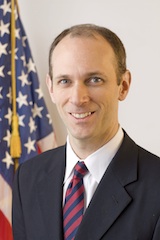
This week at a conference, I listened to featured speaker, Austan Goolsbee, who is President of the Federal Reserve Bank of Chicago, a noted Economist and frequent contributor to the financial press.
| Official Portrait |
An amusing story Mr. Goolsbee told made the audience roar. It was about a pleasant sense of wonder he experienced while attending a meeting in the Oval Office with President Obama and Larry Summers (the pleasant part ended abruptly)
Afterward, during the Q and A period, I anxiously awaited my turn with the microphone. My question to Goolsbee, which I'll paraphrase, was...
We hear much debate from economists and financial journalists about the likelihood of a so-called soft landing. Some say the pace of rate hikes was too slow, others say the risk will come from cutting rates too quickly. Whether the outcome will be soft or hard, what exactly constitutes "a landing". In other words, how will we know who was correct?
I watched Dr. Goolsbee as I asked my question and witnessed his nodding head. Then he gave a relatively lengthy answer. His points were:
| Official portrait, 1981 |
"Thanks for your response. You mention I should share my thoughts with the State GOP. Fair point. Reagan’s “Eleventh Commandment” applies to all Republicans.
I’m approaching retirement which will free up my time to learn, but right now, I won’t pretend to be steeped in state politics. I know Vos is controversial to say the least and I have much to learn about the influences of the lobbies in your message. I have no reason to doubt the veracity of your claims about who’s ruling the roost and those special interests concern me.
Now, for added context on where I’m coming from, bear with me….
I’m a lifelong Wisconsinite who’s voted Republican at state and federal levels for 42 years. That’s right. I’ve not cast a single vote for a Democrat and never regretted it -- but these days -- my party is at war with itself and we’re fighting Dems with one arm tied behind our backs. Two Republicans at odds with each other often forget they both have more in common with each other, than either person will ever have with Democrats.
I’m a pragmatist because without victory in key elections, we improve little. You write about good quality candidates vs. establishment types. I’m not sure what constitutes an establishment candidate, but I’ve seen GOP candidates, who say the right things, but prove to be ineffective campaigners: Tim Michels for Governor (Rebecca Kleefisch would’ve been better), Tommy Thompson (as much as I admire all that he did in his prime as Governor, his effort for a US Senate seat against Baldwin was miserable), Sarah Palin (she almost single-handedly sunk McCain) etc. Were these candidates establishment, or non-establishment types? I’m not sure the label matters. They all lost.
Either way, we need to allow room for debate within the GOP without destroying each other. For example, I’ve long admired Paul Ryan for his fiscal sanity and unflappable temperament in the DC cesspool, but I totally disagree with him about his choice to not vote for Trump. It’s a binary choice in November. If one does NOT vote for Trump, one is by definition helping Harris.
On the other hand, Trump’s ridiculous remarks about Ryan being the worst Speaker of the House in American history and all the compost Trump hurls at other decent Republicans needs to be countered and freely debated within the party. If it isn’t, then Ryan becomes correct about Trump being a Non-Conservative Populist requiring total fealty from the rest of us.
There’s a common theme here--I see few conservative voices on college campuses, little balance in the mainstream media, and little to no tolerance for disagreement within Republican caucuses whenever Trump comes up. Conservatives must get together, allow reasoned debate among us and run GOP candidates who can win in Madison and up ballot.
![]() |
Some of these items are mere dislikes, others do indeed involve deep loathing. You decide which is which. 😇 (freepik image at right)
THINGS I DON'T CARE FOR:
1. Merging traffic.
2. Political posturing at non-political events I pay to attend and political posturing at non-political events that I don't pay to attend.
3. Any sort of fruit placed on a pizza. (Yes, technically tomato is a fruit but let's forget that).
4. Most reality TV shows.
5. Shiny, spherical orbs placed on pedestals to adorn a front yard (or fake deer).
6. People who prey on the weak or disadvantaged.
7. People who covet criminals' rights over victims' rights.
8. Several MSNBC commentators.
9. The short-lived customer satisfaction that comes from driveway asphalt sealing.
10. Small plates dining.
11. Diet Coke.
12. Insects, snakes and cats.
13. Aggressive, unleashed dogs.
14. Our border controls (or lack thereof).
15. More than 3 consecutive days without sunshine.
16. Lawn and garden weeds.
17. Loud bars or restaurants where one can't hear a companion's voice.
18. Democrats' party leadership.
19. Potholes.
20. School bullies, car jackers, muggers, rapists and the lot.
21. Indifferent customer service representatives.
22. Marshmallows.
23. Dirty public restrooms.
24. Drivers who don't use their directionals.
25. Excessive undulation on greens. (in heaven, all greens must be perfectly level).
![]() |
| Image by Racool_studio on Freepik |
To attend a major league baseball game, is to participate in a thoroughly American experience. It's a classic sport with something to delight everyone. As spectators, we usually can forget about life's problems for a few innings. Or, at least we could.
Now, the MLB, its franchise owners, the players union, or some combination thereof, have joined the ranks of those in the NFL who thought it was a great idea to radiate political messages in giant letters in the endzone. (And even allow messaging on the back of player helmets).
I hadn't noticed anything similar in professional baseball until recently. Just beyond the center field wall at Target Field in Minneapolis, one can see, one actually must see, a large sign blaring two words: "END RACISM".
Who are proponents of the Target Field signage going to influence? Put another way, who besides actual racists, would advocate for preserving racism? This practice of adorning stadiums with political messages could beckon all comers for equal expression. One day will we see a large "END WOKEISM" or "BACK THE BADGE" sign in the right field bleachers? I hope not, because overt political posturing -- whether Conservative or Progressive in nature -- does not belong at sporting events.
All forms of injustice, including racism, are abhorrent. We all salute those who fight injustice, but every citizen has a right to pay for and receive the pleasurable escapism of attendance at a sporting event (or a "Hamilton" performance) without political messaging.
Now, other changes to the game of baseball have been welcome and they involve no political expression whatever, so let's go there....
Many games were simply too long, but by adding the pitch clock, limiting trips to the mound for pitcher chats and implementing other measures for extra inning play, the MLB has effectively shortened average game time, while preserving the experience for fans.
Many unnecessary delays involve the pitcher in some way, shape, or form. Relief pitchers warm up in the bullpen, so why not reduce the amount of time they can burn after taking the mound before they face their first batter?
If the manager is going to call for that relief pitcher, why can't he just signal that from the dugout. His slow walk to the mound followed by on field discussion with the manager, catcher and a friendly pat on the back of the outgoing pitcher--is followed by more mound chat. Just zip Joe Reliever in a golf cart directly to the mound and play ball!
Finally, a personal wish. Let's keep home plate umpires, but use technology to perfectly call balls and strikes. Way too many strikes are called balls and vise versa. Allowing technology to decide how an umpire calls a pitch, would avoid disputes over poor calls and limit fan and player aggravation over all of those truly God awful calls.
Traditionalists may bristle, but the technology could be implemented without removing home plate umpires from the sport. Aside from the benefits of accurate officiating and stress reduction, the change would equate to another timesaver.
Baseball fans vigorously debate changes like these, but they do so in the context of what's good for this sport that's lasted over 180 years. Such debates don't involve political ideology today. I hope they never do.
Check out my latest post on LinkedIn if you are interested in the common question designed to tell an organization something useful about customer satisfaction and loyalty.
"On a scale from 0 to 10, how likely are you to reccomend us to a friend or colleague?"
Aside from leading marketers to easy conclusions, singular use of the NPS question is annoying to me. For some of us, it's simply not the question we want to answer, nor do we want our views confined to a Likert Scale for marketing purposes.
I suspect some NPS devotees just don't want to deal with unstructured data. Perhaps more marketing heads will require their surveymonkeys to leverage AI and mine that data that tells them so much more than a checkbox.
![]() |
| Image by upklyak on Freepik |
![]() |
Film titles in alphabetical order...
(Image above by freepik)
![]() |
Many of my reactions as a consumer come in oral rather than written form. For example, a couple of months ago I left a voice message for a service manager about outstanding service I received from one of his auto technicians. Last month, I spoke directly with the restaurant chef to compliment his dish, after telling his manager about it.
In essence, the majority of my reactions as a consumer -- whether published online, or spoken, are positive. This past week was abnormal in that I published two reviews of healthcare professionals: one an Orthodontist (positive) and the other an Optometrist (negative).
The hyperlink to the Orthodontist will take you to the website associated with this business that dispenses superb care and service; in my view. I issued a glowing, albeit brief, "5 star" , Google review for them.
The hyperlink to the Optometrist, will take you to a one star review I wrote on Yelp, which reveals my poor experience.
Note to the gentleman in the Philippines emailing me about online safety and a shared desire to root out fake reviews: thanks for your messages, but I haven't been able to confirm your identity and your website is not functional.
(Image above by freepik)
![]() |
By George Webb Corporation - http://www.georgewebb.com |
![]() |
| John Maddente photo |
2. I'm guessing few of my seven readers are familiar with Luckbox magazine. Its stated focus on "Life, Money, Probability" is geared toward Traders and other professional investors. I do not belong to that group, but a copy of this magazine at an airport lounge with its snappy graphics and offbeat topics, drew me in.
The latest issue has an interesting article on the high stakes fight to preserve, or slowly kill, AM radio. The piece reminds readers that AM radio remains relevant to 82 million American listeners and also government officials that rely upon it as a medium for public emergency alerts. What's more, AM radio defenders in Congress are remarkably bipartisan.
I close with a friendly jab at the Luckbox editor of this article.
Dear Madam or Sir, Re: the copy of "Night Radio" -- I believe your columnist intended to cite the laws of physics not "psychics". Your oversight reminds me of a M*A*S*H episode whereupon Col. Potter exclaims, "We order rectal thermometers, we get spark plugs. Both useful articles, but hardly interchangeable."
![]() |
There were two parts to Trump's NATO invective. The first should be ignored as "noise" and the other should be heeded as a "signal". First, the ridiculous assertion that he'd invite Putin to invade NATO countries that don't pay their bills should be ignored, but the second one about NATO members not paying their "bills" requires closer examination as a signal.
One problem with the American Left, is that they fail to understand why Trump was elected in 2016 and instead they focus on Trump's hyperbolic noise which, to be fair, is often preposterous or dangerous. However, I believe that most Trump barbs and threats are designed to agitate others, fire up the base and keep him in the headlines.
In this case, I heard a podcast commentator -- obsessed with Trump's use of the noun "bills" -- remind listeners that NATO "is not a country club" with its members getting billed. That observation is just noise. Of course, no administrative entity issues annual dues invoices to 31 member nations, but members have agreed to fund a minimum of 2% of their GDP to pay for their own defense.
In the last report by the NATO Secretary General (the 2022 report was issued before Finland became a member in 2023) just 7 of the 30 NATO member nations met their minimum 2% of GDP military spend commitment. That's the signal and Trump is right. Most NATO countries are not paying their share. The rest is just noise.
(Image Above By freepik)
The WSJ editorial team nailed it today: https://www.wsj.com/opinion/50-year-mortgage-donald-trump-bill-pulte-housing-prices-5ca2417b?st=N1W...